
How to identify recyclable packaging?
18/08/2022Have you ever noticed that, on labels or on the plastic packaging itself, there is a triangular symbol formed by little arrows and inside of it, a number from 1 to 7?
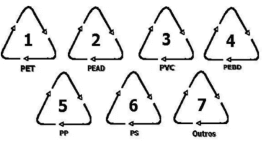
Many times it goes unnoticed, but it is there for a very important reason: to identify the type of plastic that that package is made from in order to facilitate separation and recycling. For this reason, it is important to always check the label.
The use of this identification system is not necessarily mandatory, but it is widely used by manufacturers, precisely because of its impact on recycling and the circular economy.
Identifying the packaging material
Now that you know what these numbers are, how about knowing what type of plastic each number corresponds to?
1 PET (Polyethylene Terephthalate)
Widely present in our lives, especially in water and soft drink bottles PET is one of the most common recyclable plastics.
It is a thermoplastic, which means that it can be heated and melted without losing its characteristics, making it a highly valued material in the plastic chain, from the collectors to the producers of consumer goods, therefore, it has high recycling rates.
2 HDPE (High Density Polyethylene)
HDPE is a versatile material, widely used in the manufacturing of lids and packaging, such as fabric softener bottles, bleach bottles, shampoo bottles, grocery bags, jars and housewares. It is unbreakable, resistant to low temperatures, light, impermeable, rigid, and has excellent chemical resistance.
3 PVC (Polyvinyl Chloride)
PVC is known for its use in construction, water and sewage pipes, but it can also be found in packaging, such as edible oils, mineral water and mayonnaise jars, for example.
4 LDPE (Low Density Polyethylene)
LDPE is a type of plastic that is flexible, light, transparent, and impermeable, used in the manufacture of bags for grocery stores and supermarkets, milk, food such as bread, cold cuts and sausages, and hospital supplies.
5 PP (Polypropylene)
PP is produced from propane gas. It has the characteristics of being unbreakable, transparent, shiny, rigid, and resistant to temperature changes, as well as retaining flavors very well. This is why PP is used in
packaging and food films as well as in the manufacture of industrial and civil construction products, such as ropes, hot water pipes, wires and cables.
6 PS (Polystyrene)
Lightweight, thermally insulating, low cost, flexible and moldable under the application of heat, PS is used to make yogurt, ice cream and candy packaging, bottles, appliance, toys, and some disposable products, such as plastic cups and plastic shaving razors.
7 Other
In this category are all other polymers. One of the most common is BOPP (bioriented polypropylene), found in snack food packages, cookies and potatoes, for example. It can be recycled when it is not in adhesive form since the glue makes the recycling process unfeasible.
Have you identified the packaging material that you are going to discard?
Now all you have to do is to separate it and wait for the selective collection. If your city does not offer this service, all you have to do is contact your city hall about adequate disposal sites.
Recycling at Valgroup
In addition to being one of the largest producers and processors of plastic in the world, Valgroup is also one of the largest recyclers. In fact, the company was founded as a recycler.
Valgroup is constantly investing in the expansion of its recycling capacity, aiming to reach one of its main environmental goals: to recycle 100% of the volume produced as of 2040.
Learn about Valgroup’s environmental commitments at www.valgroupco.com/en/sustentabilidade/
Stay tuned in to the world of plastic technology, innovation and sustainability
Embalagens para pet food: evolução do consumo exige desempenho e inovação na indústria
Continue reading
Lindoya Verão lança embalagem shrink desenvolvida com a Valgroup e premiada no Prêmio Embanews
Continue reading
Comerc Energia and Valgroup expand their partnership and enable 100% renewable energy consumption
Continue reading
Valgroup, Dow, and the Circular Movement launch in Brazil the first coffee packaging designed for recycling
Continue reading
Digital Printing Valgroup connects brands and consumers
Continue reading
Valgroup’s Antistatic Additives: efficiency and safety in plastic films
Continue reading
Valgroup and ExxonMobil collaborate to develop high-performance Stretch Hood films without EVA
Continue reading
Brazil recycles 410 thousand tons of PET and consolidates circularity in the sector
Continue reading
Valgroup launches solutions focused on end-of-line automation
Continue reading